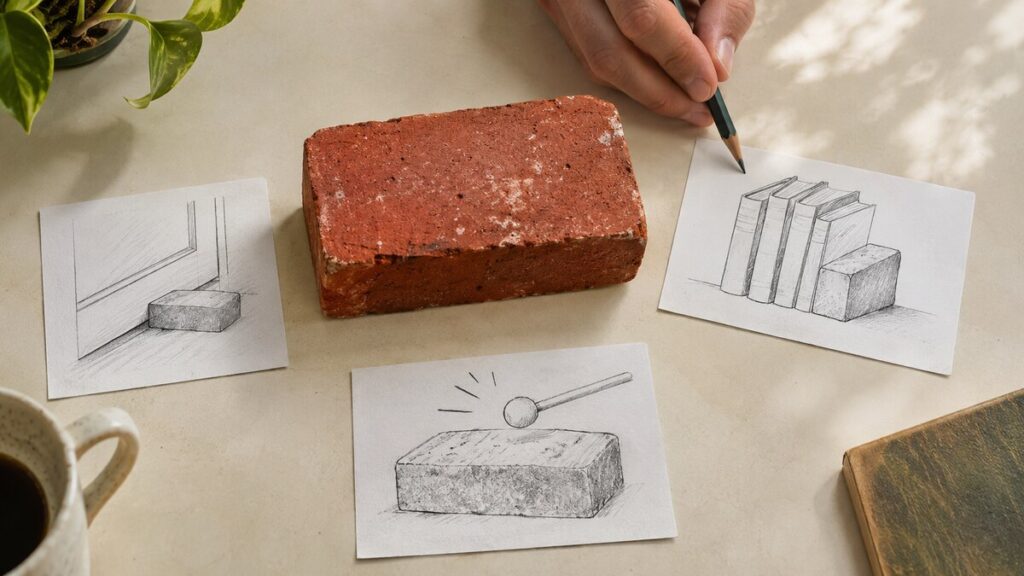
Give a group of people an ordinary brick and ask for unusual things to do with it. One person sees a doorstop, a paperweight and a bookend. Another imagines crushing it to make pigment. A third writes fourteen variations on building a wall. Who has done best? Before testing whether cannabis changes creative thinking, a researcher has to decide what to count.
Three answers can be one idea in disguise
The alternate uses task invites people to generate possibilities for an everyday object within a time limit. A simple score is fluency, or how many acceptable responses somebody produces. Flexibility asks how widely the responses range across categories. Originality asks how unusual they are. A long list of things to weigh down may score well for fluency and poorly for flexibility. A lone proposal for a red pigment could fare quite differently.
The classification takes judgment. Is a bookend a weight, a support or a furnishing? What if someone proposes using the brick as a striking instrument, then as a prop in a percussion performance? Clear rules and independent scorers reduce the risk that a researcher’s fondness for music decides the outcome. One alternative is to ask participants to nominate their strongest ideas. Research on scoring those selected answers shows that how many ideas count and how much time a participant has are substantive design choices.
In a controlled study with regular cannabis users, researchers compared placebo with two amounts of THC in vaporized cannabis. They included a task asking for alternate uses and another requiring answers to word associations. The higher THC condition impaired divergent-thinking performance. The lower condition supplied no clear evidence of an advantage over placebo. Those details get lost when the result is compressed into a claim about creativity in general.
Finding a single connection
The second kind of puzzle works the other way around. Suppose the clues are “birthday,” “layer” and “crab.” One word, “cake,” makes a familiar expression with each. There may be many things one could say about the three clues, but the task rewards finding a particular connection. A person can be good at generating alternatives and poor at recognizing the one an experimenter has in mind, or vice versa.
The distinction also affects what a wrong answer means. Silence at the end of a word puzzle could reflect a narrow vocabulary or an unfamiliar expression. A participant with an inventive but unconventional answer to an alternate uses task may be exactly the person the scoring system was designed to notice. The very same instruction to “be creative” offers little help in telling these performances apart.
Why the person holding the brick needs a comparison
If somebody proposes a remarkable use after taking cannabis, it is natural to remember both events together. What would that person have proposed under placebo with the same time and encouragement? The experiment makes that counterfactual less mysterious by organizing a comparison in advance. An outside scorer can also judge the answer without knowing how pleased its author was to produce it.
That last precaution matters in light of research separating judgments from output. Participants who used cannabis evaluated creative ideas more favorably without a matching improvement in independent assessments. The authors’ discussion of those results gives a useful companion to experiments that count responses. Enjoyment, willingness to propose something odd and the judged quality of the proposal are all plausible objects of study. Each requires its own measurement.
The last answer on the page
A brick exercise ends when the timer rings. A painter working with brick dust could spend a month learning that the color fades or that a binder changes its texture. Neither discovery would appear in the original score. Such tasks are useful because they isolate a manageable part of creative thinking. Read their results with the original object still in view. A count of alternate uses is evidence about what people could think of in a few minutes with a brick, and that is already a more precise claim than inspiration gained or lost.