Wanting to put on a record is not quite the same pleasure as hearing it. You can crave a particular song, listen for a favorite instrumental entrance, and find that the moment itself feels ordinary. Research on cannabis and music ran into a similarly interesting distinction when listeners answered questions about sound and a scanner recorded their brains during the experiment. Several measurements that might all be described casually as enjoyment moved in different directions.
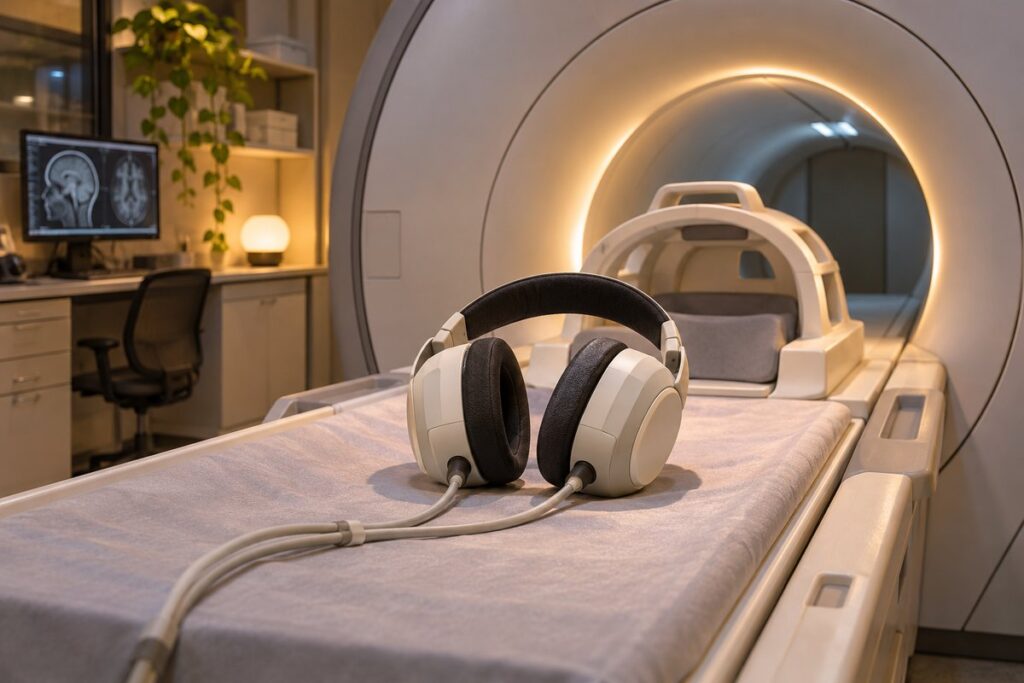
Tom Freeman and colleagues invited sixteen cannabis users to a study of musical listening with functional MRI. Each person came for three sessions, receiving cannabis containing THC and CBD, cannabis containing THC without CBD, or placebo. This arrangement allowed the researchers to compare each listener with themselves across conditions. A person who always gives music high marks, or who generally shows a particularly strong brain response to sound, provides their own point of reference.
What the listener heard
During scanning, the team compared responses to musical excerpts with responses to scrambled sound. That choice of comparison is crucial. A burst of sound can produce a response for all sorts of reasons that have little to do with recognizing or enjoying a piece of music. Contrasting an intact excerpt with scrambled material asks what distinguishes the response to organized music from the response to the chosen acoustic control.
Functional MRI measures changes related to blood oxygenation. An experimental investigation of the signal shows why neuroscientists treat it as an indirect index of neural activity. In this music experiment, a “smaller response” means a smaller measured contrast under the relevant conditions. It would take more evidence to say a listener had heard fewer instruments, felt less pleasure or missed a particular note. None of those details is encoded as a readable item in a brain image.
The person who wanted music
After either active cannabis preparation, participants reported a greater desire to listen to music and a heightened perception of sound. The ratings of how pleasurable it was to listen did not show a corresponding increase. A person could plausibly be eager to hear the next excerpt, attend closely to its texture, and still give the excerpt much the same pleasure rating as on another visit. Each answer made sense on the scale on which the researchers had asked for it.
In the THC condition without CBD, the musical contrast was smaller than under placebo in several regions, including auditory cortex and the right ventral striatum. The latter is often discussed in research on reward. Calling it a pleasure meter, however, would assign the activity of a whole brain region the meaning of one specific answer on a questionnaire. Work on anticipation and peak musical emotion gives a particularly good reason to be cautious: reward unfolds over time, including the seconds spent waiting for a passage to arrive.
What the scanner leaves outside
Sixteen people listening under laboratory conditions are a small audience. The design is strong on comparisons across visits, but it has little to say about choosing a favorite track at home or hearing the audience react at a concert. In a study of cannabis and music in a naturalistic setting, researchers paired listeners’ accounts of the experience with scalp electrical recordings. Those accounts can reveal what drew a listener’s attention in familiar surroundings. They answer a different question from a controlled comparison of two sound sequences in an MRI scanner.
The apparent puzzle shrinks once the questions are kept in view. The scientists asked whether people wanted music, how sound struck them, how much pleasure they felt and how their brains distinguished music from scrambled sound. There was no reason for those four answers to align perfectly. Indeed, the difference between anticipating a favorite passage and actually hearing it is familiar to anyone who has ever lifted a needle and put it back a few grooves.